A plan your crew works from
On their phones, kept current
Systems built around your business
The quote is in an email.
The schedule is in a group text.
The price is in your head.
The customer called, texted and emailed. You’re still piecing the story together.
I personally build the databases and integrations that connect your records, tools and operating rules into a foundation your team and AI can work from. Start with one problem. Build toward a business that depends less on you.
Talk through your businessThe hard part
I’ve heard it before. I’ve said it myself.
Adventure Idaho runs 20 trip types across two bases, with a crew of 44 at peak. Trips, people, equipment and schedules depend on each other. Every rule has exceptions.
I built a foundation of 44 connected database tables around that complexity.
The hard part wasn’t another app. It was recording how the business actually works, connecting the right information and keeping it current.
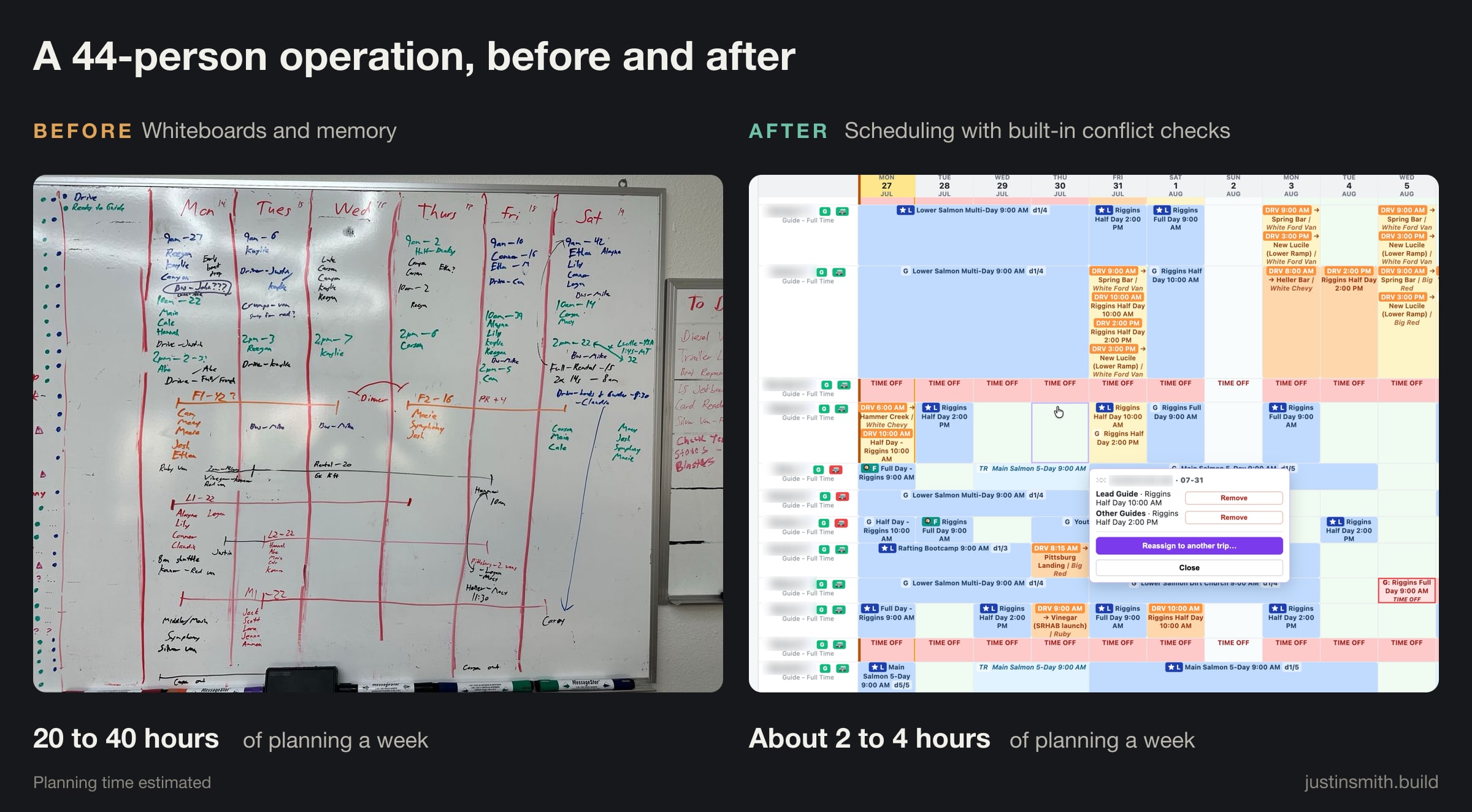
That foundation supports the dispatch board, crew phone apps and AI-assisted work. My estimated weekly planning time went from 20–40 hours to 2–4 hours.
I work with you to map how the business actually runs, connect the right records and build its rules and exceptions into the system. Then your team and AI can work from that foundation.
What you build on it
On their phones, kept current
Checked before a change
Compare records and flag what doesn’t match
Built from your records, ready for review.
Who’s waiting and what was promised
Connected records and written rules, kept current
What feeds it
Most businesses start at the top with another app. I start at the bottom.
A plan your crew works from
Tested Adventure Idaho workflow
The tested workflow checks qualifications, availability, timing and conflicting assignments, then drafts a coverage request for manager review. The replacement confirms, and the manager approves.
Only then do our schedule and team tools update.
Update records by voice or text
Actual message from our crew’s group chat.
Interpreted and staged
A person confirms. The board is updated.
I hadn’t even seen this message. By hand, I’d expect about 30 minutes checking who could cover each run, resolving conflicts, rewriting the whiteboard and preparing team messages. AI matched three assignments, checked for conflicts and staged the swap. A person confirmed it, and the board was updated.
A team message became a checked, confirmed update.
Catch mismatched records
Real billing review, simplified
Reservations3 bookings under different names
Transaction trailPayments · Partial refund
Messages and a customer spreadsheet added more context.
AI traced who paid for what Transaction history rebuilt · Seat mismatch flagged
Customer clarifies two bookings. Team reviews and refunds.
Three reservations under different names. Multiple payments and a partial refund. Texts, email threads and a customer spreadsheet disagreed with our records. AI traced who paid for what, rebuilt the totals and flagged a seat that didn’t fit. The customer clarified the relationship between bookings. Our team reviewed the duplicate charge and refunded it.
It reconstructed the transaction history, not just the balance.
Custom reports
Federal use reports
BeforeFind records · Match them up · Build the report
With connected recordsGenerate draft · Review flagged questions · Finalize
Preparing federal use reports used to take me about two full days. With the records and reporting rules already connected, the drafts were generated in seconds. The system flagged a few things for me to verify, and I checked and finalized the reports in about ten minutes.
Drafts in seconds. Checked and finalized in about ten minutes.
My estimates for preparing the reports, not building the system.
Follow-ups that don’t rely on memory
Simplified illustration, no customer data
Customer recordCreated or updated
Unclear updates flagged for review. People decide and reply.
The inquiry arrives by email. The conversation continues by text. A quote goes out through another system. You shouldn’t have to copy every update into a customer record.
I built a scheduled sweep that brings those pieces together, creates new lead records and updates existing ones. It shows who’s waiting on us, who’s gone quiet and what needs attention. Your team handles the conversations, not the data entry.
Follow up with customers. Not your CRM.
These examples come from systems I’ve built or tested at Adventure Idaho. The visuals are simplified. People approve drafted customer replies, money decisions and schedule changes.
Software billed separately. Ongoing support is optional.