Make the business easier to run without carrying it all in your head.
A schedule changes. Someone reports a problem. A customer needs an answer. You’re the person connecting the pieces.
I work alongside your team to understand the rules, connect the information and build tools that help people handle the work.
Tell me what’s getting in the way → Start with a free 20-minute conversation.
What I’ve done inside a working business
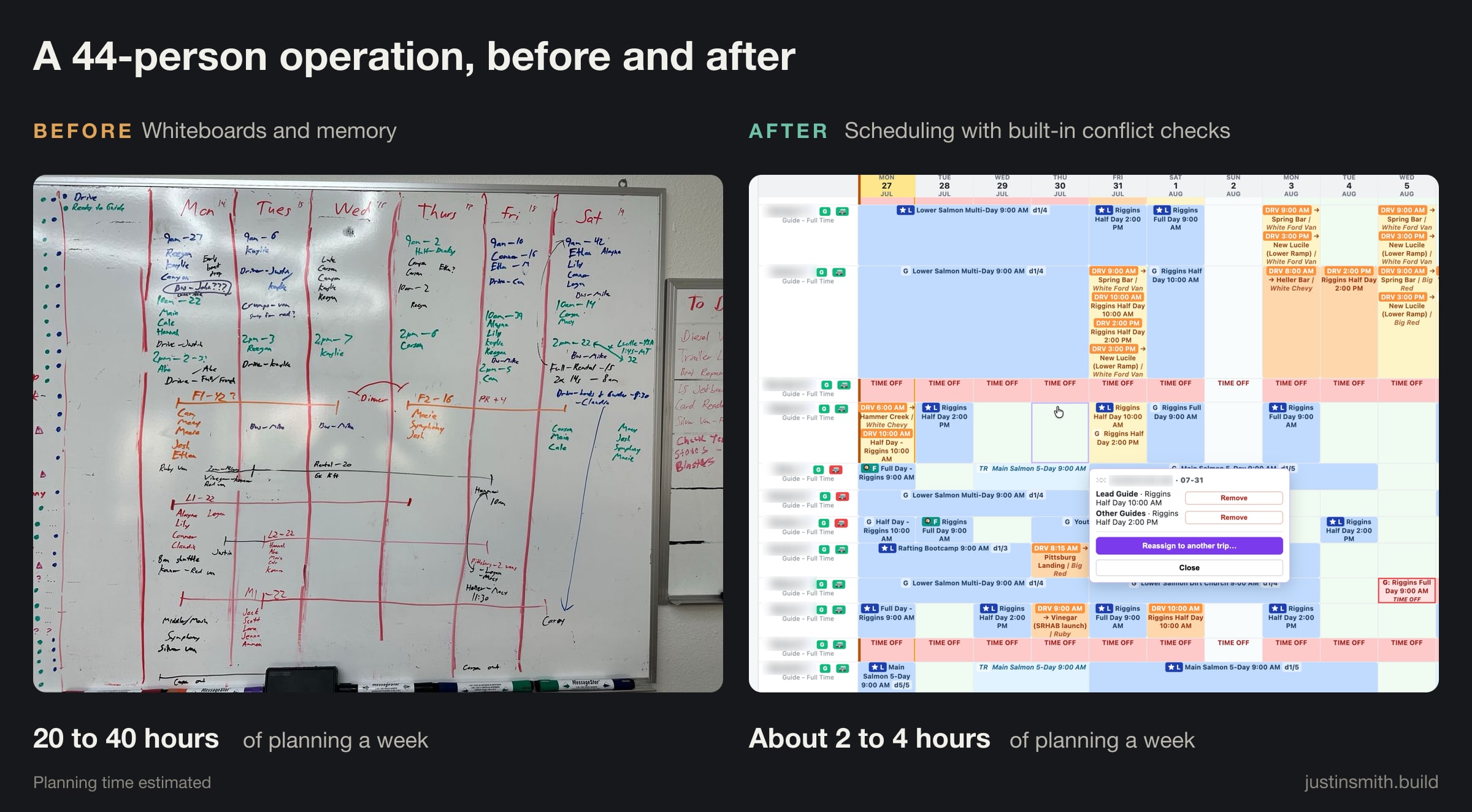
I serve as General Manager of Adventure Idaho. I’ve hired, trained and led a seasonal team of 44 at peak while building the dispatch board, crew tools and message workflows people use during the day. Behind those tools, 44 connected data tables and API connections hold the operating records and rules. I’ve also led sales, pricing, marketing and hiring, so I judge the tools in the context of the whole business. The work took leadership, training and changes made alongside the people responsible for the day.
20–40 → 2–4 hours estimated weekly planning time before and after the connected crew system
See what else it runs
- Scheduling: employees, vehicles and equipment checked together
- Qualifications: credentials, job requirements and expiration dates
- Maintenance: vehicle issues and outstanding repairs tracked
- Tasks and accountability: reports become assigned work with an owner and follow-up
- Communication: field updates, reminders and operational alerts
- Payroll preparation: work records checked before handoff to the payroll provider
- Supplies: menus, inventory and shopping lists
- 1,279 → 4,709+Customers in a season as the broader business grew
- Nearly 20× website traffic4,944 → 97,486 annual unique visitors
- 5.0 stars / 650 reviewsCustomer reputation as the business grew
- 20 to 40 hrs → 2 to 4Estimated weekly planning time
- 100+ guides trainedThrough the training program I built
- 44 connected tablesOne model of people, equipment and operating rules
- Built the dispatch board and crew appsReplaced the whiteboard with connected assignments, qualification checks and conflict visibility.
- Connected sales and communicationsRead-only booking data, inquiry checks, balance follow-up and team notifications help unfinished work surface for attention.
- Customer records that keep up automaticallyThe scheduled sweep creates and updates our own lead records from matching email, texts, quotes and available call history or notes. Connected booking and payment records can show booking status and whether payment was received. It flags recorded promises and who may need a reply for a person to check.
How the connected system works · The crew board · The training program
What the team can handle together
Plan the work
Connect scheduling with qualifications, people, vehicles, equipment and customer commitments. The crew can see assignments and changes without routing every question through one person.
Catch what changed
Availability, conflicts, maintenance and cancellations surface against the plan. Booking data can be read and reconciled with our records; the current booking connection does not write operating decisions back to the provider.
Follow through
Checklists, SOPs, assigned tasks, reminders and updates reach the right people. Work records can be checked for payroll preparation and handed to the payroll provider. The provider or accountant handles payroll processing, accounting and tax work.
Put AI to work
I ask my phone to check crew messages or propose a change. Connected records and rules test the proposal, then a person approves consequential assignments. Money, compliance and safety stay with human confirmation.
What keeps coming back to you?
Repeated work, missing information and decisions that depend on one person are useful places to start. We choose a scope together, test it with your team and keep what helps. A clear bounded project can be quoted directly; larger work has its own agreed scope.
Preparing to step back or take over?
I can help a new owner or manager understand the work, capture the operating rules and prepare the team for a handover. See operational transition support.
How we start
Tell me what’s getting in the way
Tell me where work gets stuck. If it looks like a fit, I’ll reply personally about a free 20-minute conversation.
Send your note here, or email me directly.
A few practical questions
Who is this for?
Service businesses where coordinating people, jobs, equipment and exceptions takes a substantial part of the day: trades, rentals, field services, guided experiences and businesses across several locations. Outfitting is where my proof is deepest. We can start in one operation and decide what is worth repeating elsewhere. The business needs to provide access and authority for agreed changes.
What happens in the free call?
We discuss where work gets stuck and choose a useful starting scope. I can quote a clear bounded project directly. An optional $500 to $1,500 focused review examines one agreed problem and gives written findings and next steps. It is not required before a clear project.
When is an on-site diagnostic useful?
The $5,000 on-site operational diagnostic is for a broader operation that needs its workflows, systems and rules mapped before priorities can be set. We agree on scope and timeline upfront. You keep the written findings and recommendations; implementation has a separate scope and price, and you may stop after the diagnostic.
What should I budget for implementation?
For a substantial implementation, $5,000 to $65,000 is an indicative range, not a quote. Price depends on process changes, databases, integrations, software, testing and team rollout. I show the scope and price before work begins.
How would we build together?
I work with the people who will use the tools, usually over several weeks. We connect what already works, test priority workflows against real situations and adjust the rules as the team uses them. Access is limited to the job, changes leave a record and consequential decisions stop for a person.
Will we have to replace current software?
I assess what you already use, connect what works and compare replacement or custom work when a limitation has a clear cost. I weigh migration, hosting, maintenance and support before recommending a change. Custom software is not automatically cheaper.
What will my business own?
Your business controls its accounts and data and owns the agreed custom deliverables. I document the workflows and handoff. The proposal names third-party licenses and any reusable components with their terms.
What happens after handover?
Your team can run the work in accounts it controls. Software still needs upkeep. Monthly monitoring, fixes and improvements are optional and separately scoped, never unlimited support. I identify recurring software and hosting costs before you decide.